
By Jasper Dominic Miranda & Lysander Kendrick Tiu
“What can I write for you about?”
The question hangs in the air before the first keystroke lands.
It opens every video, pop-up, and stranger’s story, spoken over the clatter of typewriter keys at a folding table in Dumaguete City. In a time of glowing screens and hurried conversations, the sound alone is enough to stop people in their tracks.
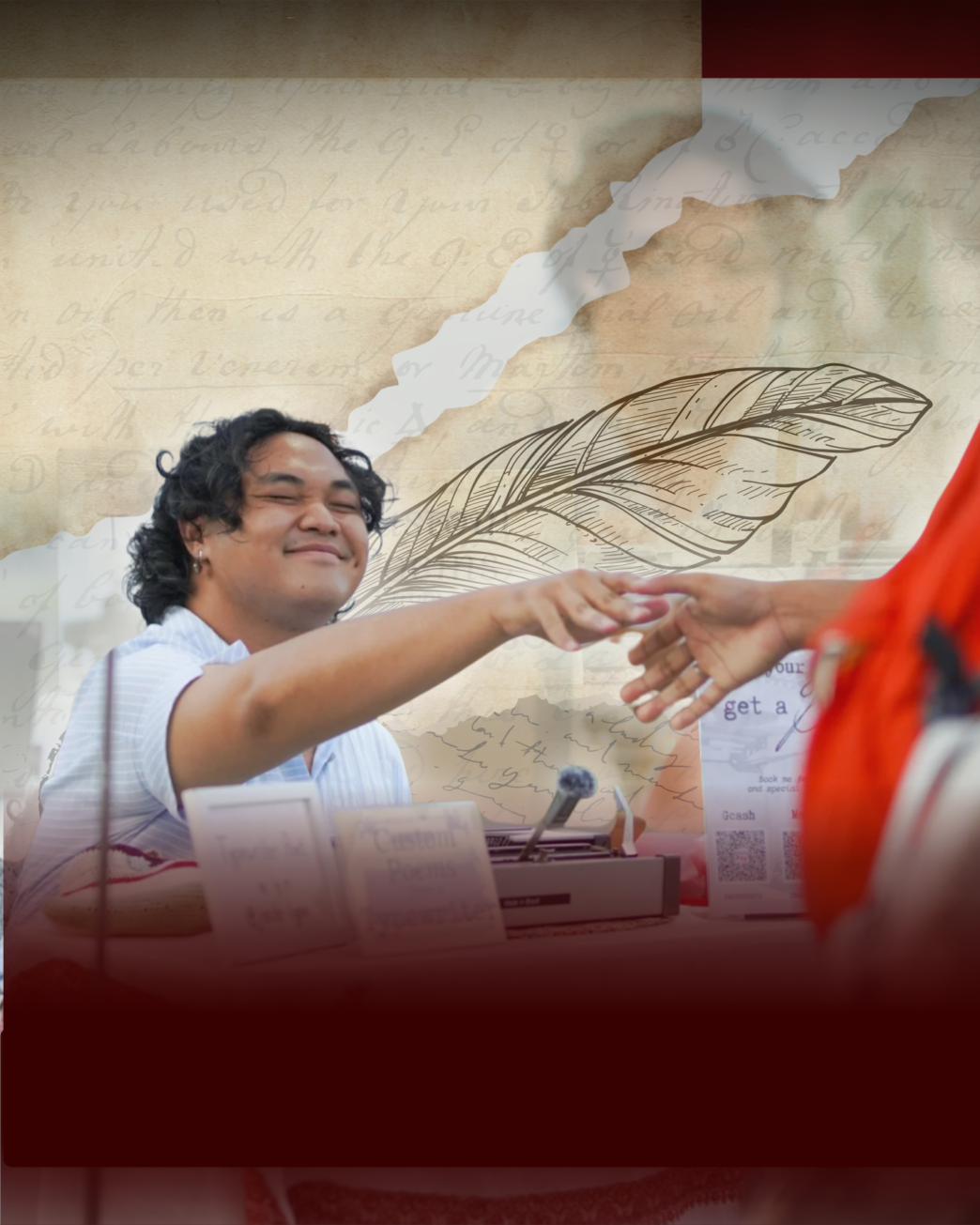
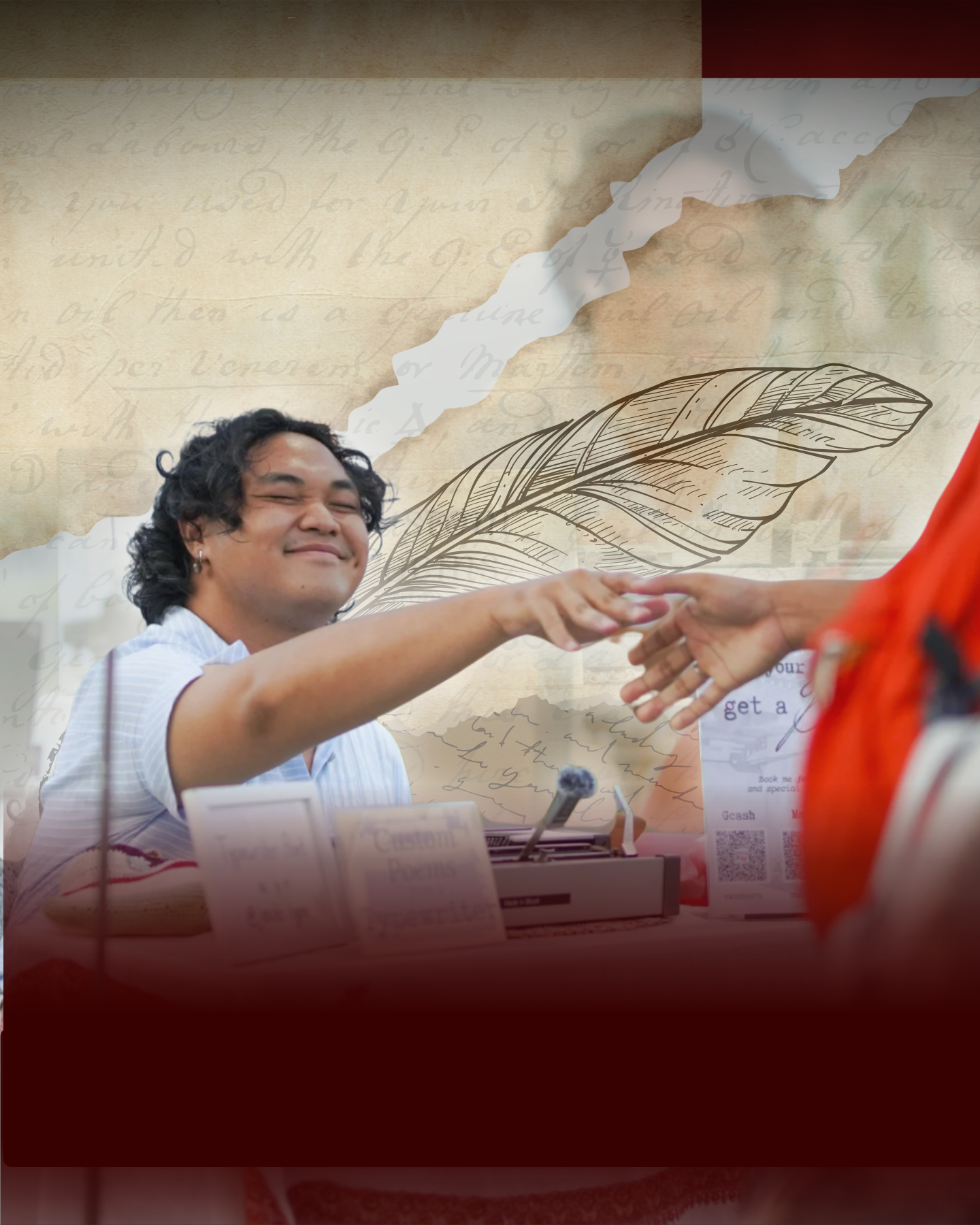
Behind the machine sits Silliman University (SU) special needs education alumnus Jecho Adrian Ponce.
From a distance, what Jecho does looks simple. Just a person, a typewriter, and a blank page. It rarely feels simple, however, once someone sits across his typewriter. Strangers approach with only a few words, a passing thought or story they haven’t fully named yet, and he listens without rush.
His poems begin not with rhyme, but with attention. He listens first. Images come next. The words follow.
“You always have to connect to the person; I immediately go for images, because if you start with something concrete already, the figurative language starts forming itself,” Jecho said.
Then, Jecho writes each poem on the spot, with no draft, no delete key, and no second attempt, for someone he has only just met. This kind of immediacy is rare nowadays, when everything is polished and corrected before it is allowed to be seen.
Writing well under that pressure is harder still. Whatever line comes out first is the only line he gets, with no chance to revise once it is on the page. That immediacy is the heart of his work, an exchange of a stranger’s story for a few lines of verse, written only once.
Jecho borrowed a typewriter for his first cafe session in September 2024. Three months later, he bought one of his own and slowly built an audience, first through pop-ups, then through the videos that kept a record of poems he would otherwise never see again.
Since his first paid typewriter session, Jecho has turned sidewalks, cafés, and campuses into places where strangers tell stories they have rarely said out loud. Every conversation opens the same way, but no two poems ever come out alike.
“Stories can come from so many sources, and for me, it’s these strangers who are first intrigued by what I do. It opens them up to share their own stories. We’re exchanging different forms of art. Mine is poetry, and yours is your own experiences as a person,” he said.
Poetry entered his life years before the typewriter did. Jecho started writing about eight years ago in junior high school, where he was drawn in by the hugot lines he saw online.
Four journals later, he was performing spoken word with Dipag Inc., a collective in his hometown of Dipolog City.
Love poems, however, are not the usual request. More often, strangers arrive carrying grief, uncertainty, family struggles, or impossible decisions. Some simply need someone willing to listen without judgment.
“I’ve had people who were struggling with preserving their own life,” Jecho said. “Some people are just being bullied, some people are at crossroads between two different decisions.”
The stories he hears are often heavy. The poems are not always.
A customer once handed him just P50 for a poem, but walked away with tears in their eyes. “They went away feeling fulfilled, having a few of their questions answered. Reflecting on what has happened in their lives. That can be more than enough,” Jecho said.
His favorite topics to write, though, are for children, whom he tries never to charge. Their requests are usually simple and sincere. Jecho mentioned a girl who came back three times, asking first for a poem about her stuffed turtle, then her real turtle, and later, her love of swimming.
For him, writing for children is a reminder that poetry does not need to impress. It only needs to connect with what already matters to a child: a stuffed turtle, a real one, an afternoon spent swimming.
Jecho has learned that listening to hundreds of strangers can be heavy, taking a toll on his health. To manage it, he journals when a story lingers too long, then lets it go after the poem is done.
“It’s not that I don’t care about the person,” he said. “It’s more a way for my body to keep doing what it does, so it doesn’t weigh me down. I go home smiling still, because I’ve done my part. Your story continues with you,” he said.
That balance, between carrying a stranger’s weight and letting it go, is as much a part of his craft as the writing itself. He does not get to cross out a line and start over once the words hit the page, so what he does with the weight afterward matters just as much as what he puts down.
The strangers he’s met have since carried him beyond Dumaguete. A regular customer flew him to a family reunion in Bohol once. Another booking will bring him to Davao this October.
Within SU, he found an early audience through a SU Student Government Advocacy Committee event, then later edited poetry for Sands and Coral.
Despite not studying creative writing in college, he credits his education in special needs for grounding him with empathy. This, he says, allows him to listen closely to strangers’ stories.
He is now reviewing for the licensure exam for teachers and has given himself a year, with his parents’ agreement, to see how far his poetry can go. His goal is simple: become a full-time poet.
He plans to travel with his typewriter, taking his poems to Bohol, to Davao, wherever the next stranger’s story calls him, but Dumaguete will remain home.
It is the city where he first sat behind the typewriter in September 2024, where he found his earliest audience, and where every trip away eventually leads him back.
That sense of place ties into something larger than his own craft. Dumaguete carries the UNESCO City of Literature recognition, and Jecho is quick to say that title rests on a literary history far older than his own.
If he has added anything to it, he hopes it is making more people curious enough to visit, sit across his typewriter, and tell their own stories.
The gratitude does not always come right away. Long after a poem changes hands, messages arrive from strangers telling him how much those few lines meant.
“What keeps me going is people’s reactions to my poems. I have a lot of message requests [from] people telling me how much my craft actually helps them. I never really get to think you’re making an impact on people’s lives. That’s always what motivates me,” he said.
Every poem begins with the same question.
“What can I write for you about?”
Someone always answers. For a few minutes, he carries their story and returns it in verse. Then, with the last strike of the typewriter key, he gives it back, leaving behind the relief of being understood and the comfort of hearing one’s life through someone else’s words.
And every time he asks the same question, he offers the same promise—that whatever is said next will be listened to, written down, and returned as something worth keeping.