by Daniel Enrico
Behind the secret recipes of baked siopao, cheesebread, crinkles, and more pastries served in the school cafeteria are workers who have spent decades in the kitchen. Every day, they do more than prepare meals or feed students. They carry responsibilities beyond the cafeteria walls and quietly build lives of their own. If there is one ingredient that lingers in every serving, it is dedication.
Since the late 1990s, the Silliman University (SU) Cafeteria has been known as the second-oldest food establishment in Dumaguete, Philippines, and as a hub for the town’s best-selling merienda staples. The cafeteria that has served generations of students is far from what it once was. From a wooden kitchen to a renovated facility, and from making bread by hand to using machines, it has evolved over the years.
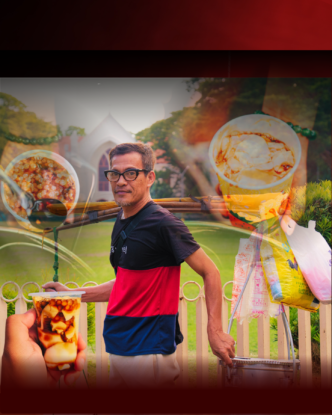
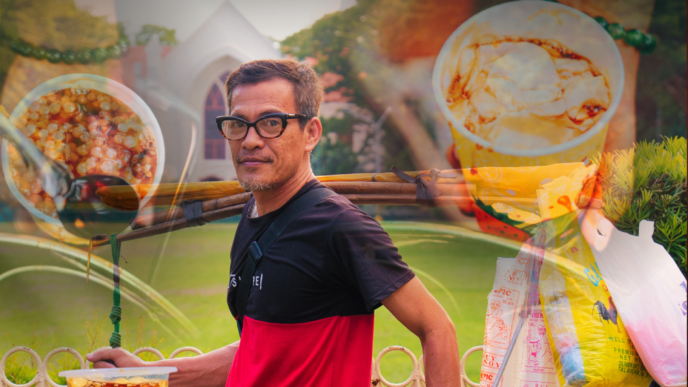
Restituto Perez
Before the smell of freshly baked bread fills the cafeteria, there is a quiet stretch of road between Sibulan and Dumaguete. It is the route of a father carrying with him the thoughts of the day’s work long before he steps into the bakery.
Perez joined the cafeteria in 1997 and is now a chief baker. Inside the bakery, flour, yeast, and the steady heat of the oven have become familiar companions.
But what keeps him returning every morning is not the bread. It is the family waiting for him at home.
By the time he arrives from Sibulan, the day’s orders are already waiting. For more than two decades, Perez spent his mornings preparing pastries and decorating cakes, a routine that helped see both of his sons through college, one in Civil Engineering and the other in Sociology.
“Bisan baker, nakapahuman ko ug duha ka [anak na] Sillimanian,” he said.
[Even as a baker, I was able to send two of my children to Silliman and see them graduate.]
This route to work has changed little over the years. These days, however, it includes a brief stop at his grandchildren’s school before Perez continues to the bakery.
“Dapat naay determinasyon…ug paningkamot. Kung wala paningkamot, wala gihapon,” he added.
[You need determination and hard work. If you don’t put in the effort, nothing will happen.]
While Perez begins his mornings thinking about bread, another worker starts the day with a different responsibility.
Lodivicio Villo
In another corner of the cafeteria, another father measures his mornings through meals, ensuring that hundreds of students have food waiting for them before the day fully begins.
Every early morning, Villo, the chief cook, is already on the road, travelling from Sibulan to the University. For over 3 decades, Villo has spent his working life in the cafeteria, growing from food server to chief cook, while helping feed generations of dormitory students.
His day begins with the monthly meal plan, ensuring breakfast is ready before 5:30 in the morning.
Once the first meal is served, he heads to the Tiangge, the public market, to buy ingredients for lunch and dinner before returning to continue preparations. This year alone, the kitchen prepared meals for 462 dormitory residents in SU. Every plate, he said, carries responsibility.
Like Perez, his family has always been his greatest motivation.
However, some of Villo’s proudest moments happened far from the kitchen. One son went on to earn a degree in Computer Engineering and now serves as a military lieutenant. Meanwhile, another graduated in Social Work, and is continuing his studies through a Master’s Degree. Both are graduates of the said institution.
“Kami usa ka pamilya sa kusina…maningkamot jud mi nga mahatag jud ang quality sa food, proper time of serving. Dili man sa tanang panahon ma perfect nimo, pero at least naningkamot gyud mi nga mahatag ang the best nga serbisyo,” he said.
[We’re like one family in the kitchen. We always do our best to provide quality food and serve it on time. We can’t be perfect all the time, but we genuinely strive to give the best service we can.]
For Villo, leading the kitchen was never about the title. It was about nourishing generations of students while building a future for his family, a craft he carried with pride until his retirement this year.
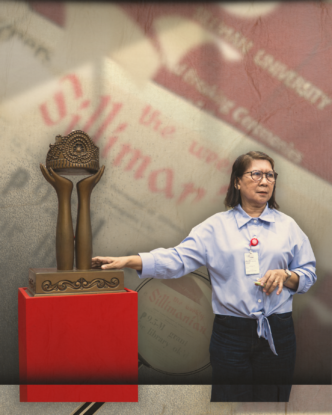
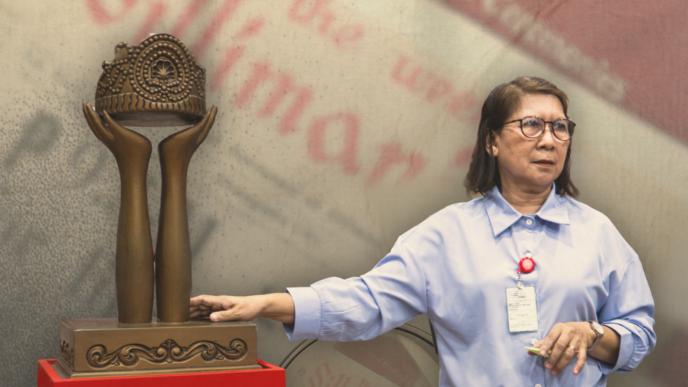
Leah Tevez
From behind the cashier’s counter is an auntie who has witnessed generations of students pass through the high school canteen, watching familiar faces leave as graduates and return years later as professionals.
For two decades, Tevez, a graduate of the University’s nutrition and dietetics program, has occupied a front-row seat to countless student experiences. Some rushed in between classes to buy food. Others stopped by after long lectures for a warm meal.
“Naay times before makasugata ko ug sasakyan, mu kalit ra open ang window sa car ug magsulti nga ‘Hi, ate!’ Karon mga professionals na jud sila, uban sa ila kay doctor na,” Tevez shared.
[There were times before when a car would pass by, the window would suddenly roll down, and someone would call out, ‘Hi, Ate!’ Now they’re already professionals, and some of them have even become doctors.]
Her interactions with students remind her that kindness is never too small. Through years of serving meals and exchanging conversations, she became a familiar presence in the lives of many students.
“‘Ang uban, kung gikapoy na og hulat sa ilang sukli, moingon og, ‘Ate, keep the change.’ Pero wa gyud na nako ginadawat. Akong gipasabot nila nga dili lang ang value sa kuwarta ang importante, kundi ang paningkamot sa ilang mga ginikanan aron mahatag ang ilang mga panginahanglan,” she added
[Sometimes, when students get tired of waiting for their change, they tell me, ‘Ate, keep the change.’ But I never accept it. I always explain that it’s not just about the value of the money—it’s also about the hard work their parents put in to provide for their needs.]
But like many of her co-workers, Tevez carried struggles that students never saw—the quiet pressure of keeping every peso accounted for after once coming up short while tallying the day’s sales. Yet, she remained at her post, a reminder that beyond every exchange of food and money is a quiet sense of dedication.
Like those who baked the bread and prepared the meals, her work rarely drew attention, yet it became part of everyday life at Silliman.
Their stories reveal a life spent in service, not only to the students they fed each day, but also to the families they worked hard to provide for. Ever since, the cafeteria has been more than a workplace. It helped send children to school, put food on the table, and carry families through life’s challenges.
Their names may never appear on the menu, but their stories remain in the memories of countless Sillimanians. Beyond the bread, meals, and smiles they served was a quiet legacy. One built not by recognition, but by the lives they helped shape, both inside and beyond the cafeteria.