
by Daniel Enrico and Lara Charmaine Lagorra
As rush hour settles over Silliman University (SU), students hurry home or to their next class while tricycles crowd the streets. Amid the bustle, a familiar vendor continues a quiet tradition that has become part of SU’s everyday rhythm.
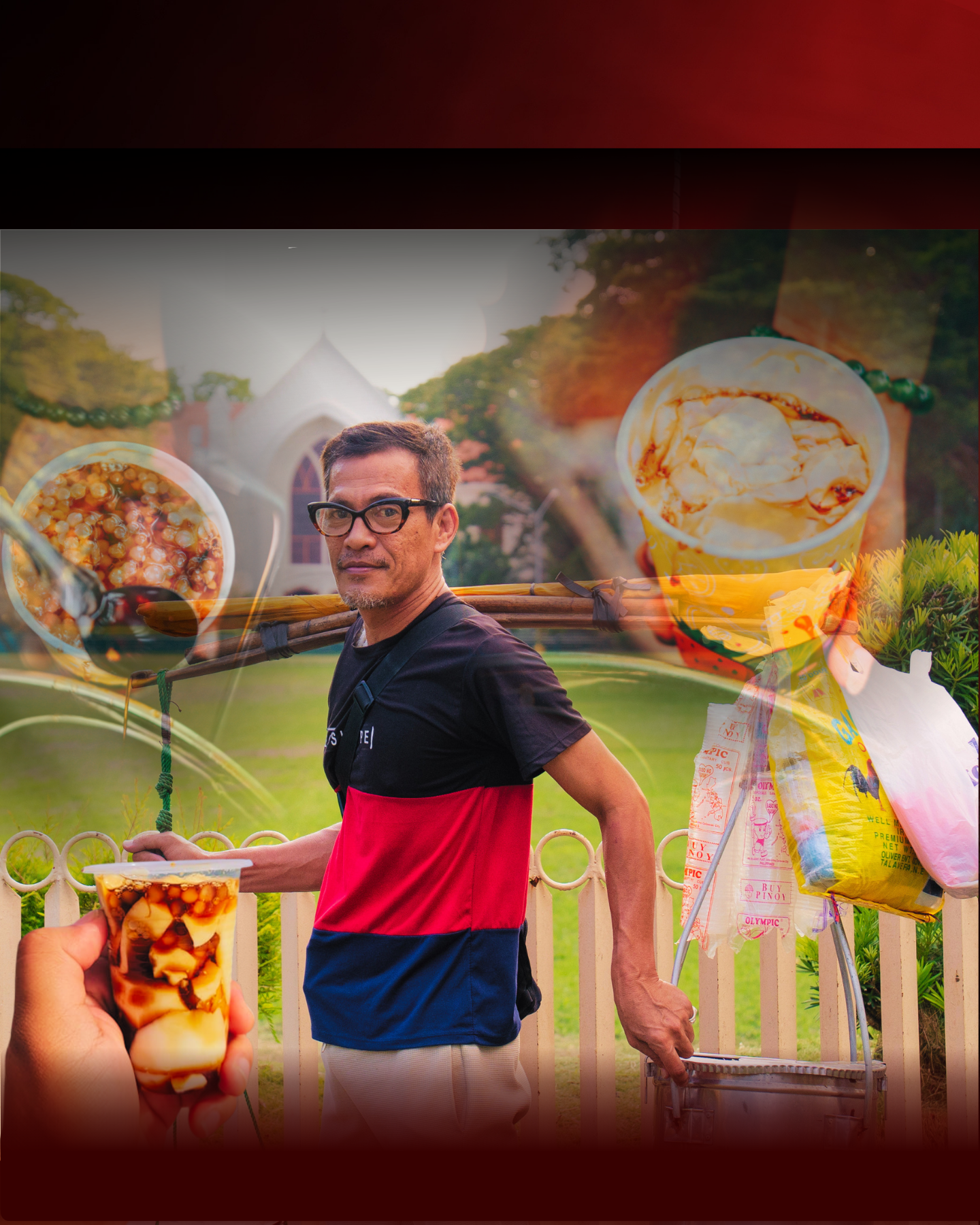
Between the road to Guy Hall and sidewalks of Villareal Hall, Rene Vigil Estrella waits by the side before beginning his rounds. He sells freshly made taho, a classic Filipino sweet snack made with silken tofu, sago, and arnibal (brown sugar syrup.)
For many, he is part of the daily routine. For him, every step is another chance to make a living, carrying not just buckets of taho but the weight of providing for his family—a story defined by years of honest work, quiet dignity, and contentment with the life he has built.
Over more than two decades, 52 year-old Estrella has been a familiar presence at SU. The life he has built, however, was shaped long before he arrived in Dumaguete, beginning with sacrifices that changed the course of his future.
He started working at 14. Growing up in a family of 11, he left school after his second year of high school. With only his mother supporting the family, he had set aside his education to help ease the responsibilities in their household.
“Ganahan man ko unta mag-eskwela ba. Paano man, magskwela gutom man mi?” Kuya Rene expressed.
[I wanted to go to school, but how could I when we were hungry?]
From his teenage years until he was 23, Kuya Rene worked a series of jobs to make ends meet, where he worked as a construction worker, security guard, porter, factory worker, canteen waiter, and dishwasher. None of those jobs offered him the stability to help his family; he had to learn things the hard way.
In 2000, after moving from Manila to Cebu, he struggled to support his family on a minimum daily wage of ₱100. Seeing his situation, his mother encouraged him to sell taho—a livelihood she knew well because it was work she had long been familiar with. Though hesitant, survival ultimately outweighed his fear of the job.
“Murag na-challenge ko. Nakahunahuna ko nga gikan man ko sa Manila ug Cebu, nganong mahadlok man ko masaag sa Dumaguete? Wala man gani ko mahadlok masaag sa Cebu. Ug but-an man pud ang mga tawo diri,” Kuya Rene said.
[I felt challenged. I told myself, if I could find my way around Manila and Cebu, why should I be afraid of getting lost in Dumaguete? I wasn’t even afraid of getting lost in Cebu. Besides, the people here are kind.]
After spending a few months selling in Cebu, he moved to Dumaguete. He began selling along the city’s Boulevard, where he gradually built a steady customer base around SU. More than two decades later, he continues to serve generations of students with one of their favorite afternoon snacks.
A year later, Kuya Rene was assigned to the new men’s dormitory cafeteria at SU.
Here, he began preparing the taho, a process that takes four to five hours each day. The steady hum of the grinder fills the room as soybeans are transformed into smooth, steaming soy milk. The rich aroma of the arnibal slowly rises while fresh sago simmers nearby, its pearls turning soft and translucent. Once everything is ready, the warm taho is carefully poured into the metal buckets he carries on his daily rounds.
By four in the afternoon, Kuya Rene begins selling around the University, where he stays until six in the evening before making his way to the Boulevard. There, he continues selling until nearly midnight. The work is demanding, yet the day’s earnings are never certain.
On good days, he earns between ₱500 and ₱600, while slower days bring in around ₱300. Despite this uncertainty, Kuya Rene remains grateful for the livelihood that sustained his family and helped support his only child’s education
For him, helping his child finish college carries special significance as he believes that education was something he once wanted for himself but had to leave behind to help support his family.
“Akong pangarap gyud sa una kay mahimong engineer,” he said.
[My dream back then was to become an engineer.]
Although life took him down a different path, he holds no regrets. Instead, he uses his experience to encourage students to value the opportunities they have.
“Taronga gyud ninyo inyong pag-eskwela aron malipay inyong mga ginikanan. Humanon gyud ninyo inyong kurso,” Kuya Rene advised.
[Do your best in your studies so your parents will be happy. Be sure to finish your course.]
Over the years, countless students have bought taho from him. Many already graduated, while new batches continue to arrive each school year.
“Ganahan gyud ko diri sa Silliman kay respetado ko sa mga tawo. Ang uban gani motawag nako ug ‘Tatay’ ug ‘Sir.‘ Bisan pa sauna, dako gyud nga tabang ang Silliman. Kung wala ini, wala pud ko diri karon,” he expressed.
[I really like it here at Silliman because people treat me with respect. Some even call me ‘Tatay’ or ‘Sir.’ Even before, Silliman has been a great help to me. If it weren’t for this place, I wouldn’t be where I am today.]
The work is demanding and the days are long, yet Kuya Rene remains a familiar presence on campus—a quiet witness to the countless students and dreams that have passed through Silliman’s streets.
“Bisag ing-ani ko, nagbaligya ug taho, basta buhi ug walay sakit, okay ra. Bahala mao ni akong trabaho basta marangal ug pinangitaan pinaagi sa paningkamot,” he says.
[Even if this is my life now, selling taho, as long as I’m alive and healthy, I’m okay with it. I don’t mind this being my job because it’s honest work, earned through hard work.]
Each afternoon, Kuya Rene lifts the familiar metal buckets onto his shoulders and walks the same campus paths he has followed for more than two decades. Faces have changed with every graduating class, but he continues passing on the same warm cup of taho and the same dedication that has carried him through the years.
For generations of students, every cup Kuya Rene serves is a reminder that some of life’s greatest lessons are found not only inside the classroom, but also in the lives of the people who shape the campus every day.