

By Dhel Sue Cabiara and Lealina Evangeline A. Reyes
What is the story of your city? Who writes, who tells, and who reads it?
Dumaguete, the City of Stories, has long prided itself with its literary legacy that continues to thrive today. Its identity is deeply connected to storytelling, reflected in its history and in the hopes of expanding this culture.
Since 1962, Dumaguete has produced and cultivated generations of writers through workshops, festivals, and programs. The city’s literary heritage is celebrated locally, nationally, and globally, serving as the home to the Silliman University National Writers’ Workshop (SUNWW), the longest-running creative writing workshop in Asia, and Dumaguete Literary Festival.
Now, after 63 years, recognition has written itself in the story of Dumaguete.
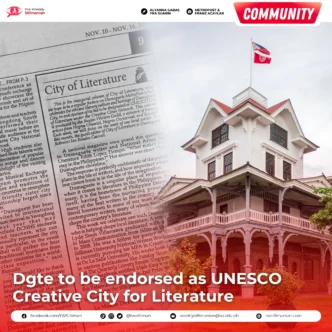
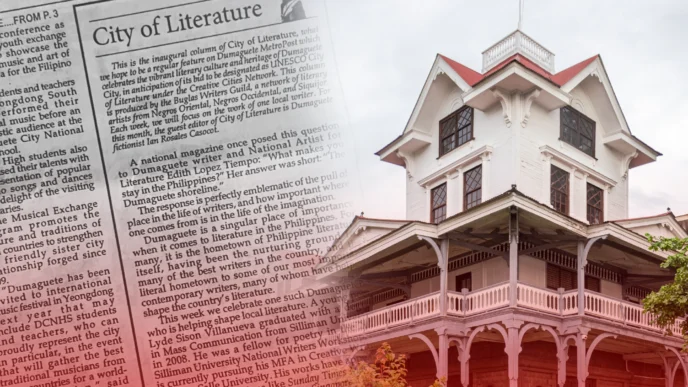
On Oct. 31, 2025, the United Nations Educational, Scientific and Cultural Organization (UNESCO) Creative Cities Network officially recognized Dumaguete as a “Creative City of Literature.” The preliminary bid for the title started in 2024, initiated by Department of Trade and Industry Negros Oriental Director Nimfa Virtucio and then-creative sector specialist Anton Gabila.
The recognition allowed Dumaguete’s literary scene to thrive and the city’s identity to expand its title as the City of Gentle People.
“[Dumaguete] has always been considered a literary city but it feels somewhat like a thing only the writers knew. But with the designation, people are now starting to use another moniker, which is the “City of Stories,” said SU Asst. Prof. Ian Rosales Casocot.
In 2024, the city also established the Dumaguete Literary Festival in celebration of the National Literature Month, inviting renowned writers nationwide for readings, panels, workshops, and exchanges on publishing.
Prior to UNESCO’s recognition, the existence of literary events in Dumaguete was something that needed to be fought for the longest time, but now, “the designation made it easy, […] it’s actually growing our [literary] community,” Casocot expressed.
With its new title, the city now finds itself bearing the responsibility to uphold its literary identity.
This July, Dumaguete held 6200 BookFest, the first regional book fair in the Negros Island Region. The event was established to introduce and sell books to locals.
Along with upholding identity and legacy through UNESCO’s designation, it also made literary events visible beyond Dumaguete.
”It is easier in the sense that people are kind of becoming more aware of the designation. So they kind of expect more literary events like this to happen in Dumaguete City,” Casocot explained.
While the title brought greater visibility, Casocot said that the city is still in its ‘baby year,’ emphasizing a planning phase focused on the long-term growth of Dumaguete’s literary scene.
”For the Literary Festival, we do want it to become international by the fifth year, […] by 2028, that’s our plan. […] We’ll be inviting international artists, international writers and also other creative cities all over the world,” he said.
The literary community also aims to partner with the local government to improve the public library’s infrastructure “that will indicate to everyone that [Dumaguete] is a literary city.”
Together with its proposed literacy programs, the community plans to establish a website to serve as a portal where writers can be hired. They are also pushing for an ordinance that will create an official City of Literature office.
For Casocot, being awarded the title serves as an opportunity to strengthen the city’s economy through its creative sector, particularly in boosting tourism through literary tours.
However, the responsibility of establishing Dumaguete’s identity as a City of Literature comes with its own challenges. Compared to the annual Duma LitFest, Casocot shared that they plan to hold the newly organized BookFest every two years or so.
“We’re only human, we cannot do everything. And we are a very, very small organization,” he said.
As a city with a heritage and identity deeply rooted and long been written through stories, “Creative City of Literature” is more than a badge of honor. It is a platform for the hands that hold Dumaguete’s pen. The same hands that hope for the city’s greatest stories to be told and continue to be written.